Skip to main content

- Same money, opposite mindsets
- The core divide: owning a company vs. lending to one
- Why the two sides play by different rules
- The leverage trick that turns 10% into 15%
- Borrowing to lend: how credit funds juice their own returns
- Frenemies on the same deal: does the wall between PE and credit ever come down?
- The diligence is similar; the focus is not
- Breaking in and moving up
- So, who actually wins?

A weekly look at Wall Street’s headline-grabbing deals.
Same money, opposite mindsets
Private equity and private credit get lumped together constantly. Same LPs writing the checks, same sponsor-driven deals, same illiquid, non-traded assets. But strip away the shared vocabulary and you’re left with two businesses built on almost opposite instincts: one is hunting for upside, the other is obsessed with not losing money. That distinction shapes everything downstream of it — how each side underwrites a deal, what kind of return it targets, and which career track actually suits a given person’s temperament.



The core divide: owning a company vs. lending to one
The fundamental question is simple: what are you actually buying? Private equity takes equity stakes in companies that don’t trade on public markets. Private credit makes loans, and the definition is broader than most people assume — any lending to a company by an entity that isn’t a bank counts as private credit, whether the lender is a dedicated credit fund, an insurance company, or something else entirely. Both sit in the private markets. Both are illiquid and non-traded. But one hands you ownership and effectively unlimited upside, while the other hands you a contractual right to be repaid a fixed amount.
Why the two sides play by different rules
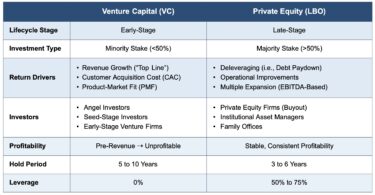
That ownership-versus-lending split drives a completely different motivation. An equity investor is trying to buy low and sell high — find a company worth 10 times EBITDA, grow the business, and exit at 15 times. A credit investor has capped upside: the loan agreement promises repayment of a fixed amount, occasionally sweetened with a warrant or equity co-investment, but rarely more than that. Because the upside is capped, the entire discipline shifts toward protecting the investment. A credit portfolio can’t absorb a string of bad loans the way an equity portfolio can absorb a few failed bets, because there’s no runaway winner sitting elsewhere in the book to make up the difference.
Those different risk profiles show up directly in target returns. On a leveraged private equity investment, funds are typically targeting at least a 15% internal rate of return, often higher. On the credit side, the underlying loan itself is usually earning high single digits to around 10% — some blend of a floating base rate, a margin, and an upfront fee. The internal rate of return, or IRR, is the metric that makes these numbers comparable in the first place: it’s the annualized return a cash-flow stream generates once the timing and size of every inflow and outflow are accounted for, which is exactly why it’s the standard yardstick for judging a private investment where money goes in and comes back out at irregular intervals.
A step-by-step breakdown of how IRR is calculated and why it’s the go-to metric for comparing private investments.
The leverage trick that turns 10% into 15%
Here’s where the two businesses start to blend together in a way that confuses people: a lot of what private equity does to hit that 15%-plus target is use leverage at the portfolio company itself. Layer debt onto the balance sheet, and a smaller equity check captures a proportionally bigger share of any value created — the classic leveraged buyout mechanic. That debt, more often than not, is being supplied by a private credit fund, which is part of why the two industries are so intertwined even though they’re chasing different outcomes from the same transaction.
Learn Online: Private Equity Masterclass
See exactly how that leverage mechanic works by building a full LBO model — the same training top PE firms use for incoming analysts.
Borrowing to lend: how credit funds juice their own returns
Private credit funds can’t lever the underlying loan itself — you can’t put leverage on top of a levered loan. What they can do is lever the fund. Take a pool of, say, 300 performing loans to a bank and borrow against that portfolio, funding part of each investment with debt that costs less than the loans are earning. The spread between what the fund pays its own lenders and what its loans yield becomes extra equity return. That’s how an asset-level yield of roughly 10% turns into a fund-level target closer to 12-15% — private credit’s version of the same amplification trick private equity runs at the portfolio-company level.
A deeper look at how leveraged loans and other debt instruments are structured and priced.
Frenemies on the same deal: does the wall between PE and credit ever come down?
Given how tightly the two sides are linked, it’s natural to wonder whether a firm with both a private equity arm and a credit arm ever just finances its own deals internally. In practice, that blurring rarely happens. Even at large multi-strategy shops, the base case is to keep the equity business and the credit business operating independently — you don’t want one financing the other, because it muddies incentives and diligence on both sides. Instead, most private credit has historically been sponsor finance: a fund investing in loans for companies that are owned by financial sponsors, with the credit provider and the equity owner as two genuinely separate parties negotiating the financing structure, alongside the lawyers who paper the deal. The engagement between those two sides is constant — but it’s a negotiation between counterparties, not coordination within one house.
A look at the group inside investment banks that manages exactly this relationship between financial sponsors and their lenders.
The diligence is similar; the focus is not
Zoom in on the actual day-to-day work and the two jobs look more alike than different. Both involve a deal coming in, digging through diligence, and building an investment case before committing capital. Where they diverge is what that diligence is optimized to find. On the equity side, the goal is identifying the market opportunity — how much the business can grow, and what it might eventually be worth. On the credit side, the goal is finding every way the investment could lose money and making sure the return on offer actually compensates for that risk. Pace differs too: a private equity associate typically goes deep on one transaction for an extended stretch, while a credit analyst usually sees a higher volume of deals with somewhat less depth on each one — which is also why credit analysts tend to stay generalists across industries longer, while equity investing has become increasingly sector-specialized.
For anyone still weighing where their skill set actually fits, a breakdown of how IB work compares to the buy side.
Breaking in and moving up
The path into both businesses used to run through a single door: two years as an investment banking analyst, then a lateral move into private equity or private credit. That’s no longer the only option — firms now recruit undergraduates directly into both private equity and private credit seats straight out of school. Once inside, the career arc looks strikingly similar on both sides: raise capital from institutional limited partners, then deploy it either into buying companies outright or into making loans to them, climbing the same analyst-to-partner ladder either way. The investment focus differs; the overall process and progression largely don’t.
Learn Online: Private Equity Certificate Program
An 8-week program with Wharton Online for anyone looking to build the analytical skills these seats actually require, no prior PE experience needed.
A breakdown of how compensation compares across the private equity career ladder.
So, who actually wins?
There’s no single deal to score here, but there is a clear answer to who benefits from understanding the split. Junior professionals win, because knowing the real difference means picking a seat that actually matches how they’re wired — chasing upside and depth on one name, or protecting capital across a wider flow of transactions. Portfolio companies win, because they can match financing to what they actually need instead of treating “private capital” as one undifferentiated pool. And LPs win most of all: understanding that private equity and private credit are fundamentally different risk-and-return engines is what lets them build a portfolio that isn’t secretly making the same bet twice.
What’s the Big Deal breaks down the forces shaping the biggest deals in finance every week. Subscribe to the podcast and newsletter to keep the analysis coming.