Skip to main content

- The deal that broke the textbook
- What a leveraged buyout actually is
- The handful of variables that drive every deal
- Why not every company can carry the debt
- How $18 billion gets financed: the Hologic blueprint
- The interest bill that breaks the base case
- EA’s $55 billion bet doesn’t look like a normal LBO — because it isn’t one
- Why sovereign wealth funds keep showing up in mega-deals
- Why financial engineering alone stopped working
- So, who actually wins?

A weekly look at Wall Street’s headline-grabbing deals.
The deal that broke the textbook
In September 2025, a consortium led by Saudi Arabia’s Public Investment Fund, Silver Lake, and Affinity Partners took Electronic Arts private in a deal worth roughly $55 billion — the largest leveraged buyout ever recorded. Run the numbers on that deal using the same base-case assumptions private equity firms use in a hundred smaller transactions every year, and something strange happens: the math barely works. Run those same assumptions on Hologic, an $18 billion medtech buyout that closed the same year, and the picture is just as uncomfortable. Both deals are proof of the same underlying truth: an LBO is not a trick you can run on any company with a printer that produces debt. It’s a bet on cash flow, on operational improvement, and increasingly, on much more than leverage alone.



What a leveraged buyout actually is
Strip away the jargon and an LBO is simple: it’s buying a company and funding a large chunk of the purchase price with debt rather than cash. The “leverage” in leveraged buyout refers to that debt, and it works the same way a mortgage does on a house. Buy a $1 million house with all cash, sell it five years later for $1.5 million, and you’ve made one and a half times your money. Buy that same house with $500,000 of your own cash and $500,000 of mortgage debt, pay the mortgage down using rental income or salary along the way, then sell for $1.5 million — and suddenly you’ve tripled your money. The asset’s value didn’t change. What changed is how much of your own capital you had at risk in the first place.
That’s the entire trick behind private equity returns built on leverage. The less equity an investor puts in upfront, and the more of the company’s own cash flow gets used to pay down debt over the holding period, the bigger the gap between what they put in and what they walk away with at exit.
The handful of variables that drive every deal
Despite the complexity of a real leveraged buyout, the model underneath it boils down to a short list of questions: what are you paying to buy the company, what do you expect to sell it for, how much debt are you placing on it at entry, and how much of that debt can the business’s cash flow retire before exit. The difference between enterprise value (the value of the whole business) and net debt determines equity value — and the more debt gets paid off during the hold, the higher that equity value climbs by the time of sale, since enterprise value minus a shrinking debt load leaves a growing equity stake.
That’s why LBO modeling is, at its core, a cash flow exercise. Analysts project a company’s revenue and EBITDA, estimate how much of that EBITDA converts into actual usable cash, and figure out how much of that cash can realistically retire debt before the fund needs to exit, typically in five to seven years.
Why not every company can carry the debt
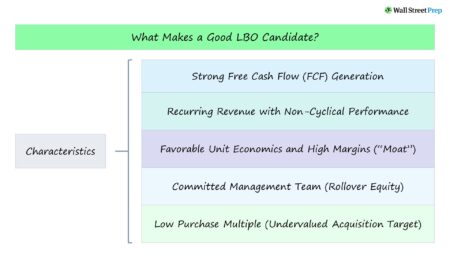
Leverage only works on businesses that can support it, which is why LBO targets share a common profile: stable, predictable, recurring cash flow. Lenders aren’t really securing their loans against a company’s physical assets — they’re effectively betting on the durability of its future cash flows. The more visibility a business offers into those cash flows, and the higher its “cash conversion” (the share of every dollar of EBITDA that actually becomes spendable cash), the more debt it can safely carry and the better an LBO candidate it makes.
What separates an ideal LBO candidate from a company that simply can’t support the debt.
How $18 billion gets financed: the Hologic blueprint
Hologic’s $18 billion buyout offers a clean illustration of how a real deal gets funded. The “sources and uses” table — the basic skeleton of any LBO, sometimes called a napkin LBO because it can be sketched on the back of one — lays out what the deal needs to pay for (the equity purchase price, refinancing the target’s existing debt, and transaction fees) against where that money comes from (new debt raised by the buyer, plus the equity check).
One detail trips people up every time: why does a buyer have to refinance debt the target already has on its books? The answer is risk. Hologic’s existing lenders had extended credit to a company sitting at roughly zero times net leverage — extremely safe. The moment new owners load the business with $11.5 billion of fresh term debt, that same company is suddenly levered at more than eight times EBITDA. Existing lenders aren’t signing up for that risk profile, so change-of-control provisions typically force their loans to be repaid at close, clearing the balance sheet before the new debt goes on.
The other counterintuitive piece: a target’s existing cash on hand actually funds part of its own purchase. Because equity value equals enterprise value minus net debt, any cash sitting on the balance sheet is baked into the price a buyer pays — and the instant the deal closes, that cash belongs to the new owner and can be redeployed to help fund the transaction itself.
How a sources and uses table gets built, line by line, for a real leveraged buyout.
The interest bill that breaks the base case
Run Hologic’s numbers conservatively and the deal stops making sense fast. At an 8% blended interest rate, $11.5 billion of debt generates roughly $4.6 billion in interest payments alone over a five-year hold — before a single dollar of principal gets repaid. Even in a generous scenario where 100% of the company’s $1.4 billion in entry EBITDA converts to free cash flow, that’s only about $6.7 billion of cumulative cash over five years. Subtract interest, and there’s barely $2 billion left to pay down principal on $11.5 billion of debt. Plug that residual debt balance into the exit math, and returns turn negative.
That gap is the whole point. No private equity firm pays $18 billion for a business assuming zero EBITDA growth and zero multiple expansion. The base case is a teaching tool, not a real underwriting assumption — actual deals only clear their return hurdles because sponsors are underwriting meaningful operational improvement, a higher “true” entry EBITDA than the reported figure, or both.
Learn Online
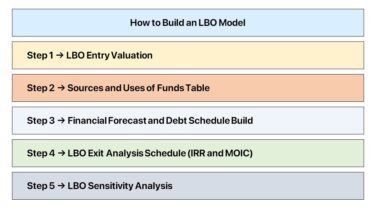
Want to build a full LBO model yourself, from sources and uses through the return waterfall?
EA’s $55 billion bet doesn’t look like a normal LBO — because it isn’t one
Electronic Arts pushes this dynamic to its limit. At a $55 billion equity value against roughly $1.8 billion of LTM EBITDA, the deal was priced at around 30 times EBITDA — an extraordinarily rich multiple for a transaction built around leverage. With about $20 billion of debt layered on top of that purchase price, the headline numbers produce an 8% IRR and a 1.5x money multiple in a base case scenario, figures that wouldn’t justify the risk of taking a public company private.
The deal only starts to make sense once the assumptions shift: instead of exiting at the same 30x multiple on flat EBITDA, model EBITDA growing toward $10 billion and the math jumps to roughly five times money. That’s a real bet on EA’s growth trajectory, not a financial-engineering play on debt paydown — which is also why the consortium behind it, including Saudi Arabia’s Public Investment Fund, Silver Lake, and Affinity Partners, looks less like a traditional buyout shop and more like a coalition of long-horizon, lower-leverage capital.
Why sovereign wealth funds keep showing up in mega-deals
Deals of this size simply require more capital than traditional commingled private equity funds can supply alone, which is one reason sovereign wealth funds and other large institutional investors increasingly co-invest directly rather than just committing capital to a fund. Co-investing also tends to carry more favorable fee economics than investing through a fund structure, and many sovereign wealth managers have spent the past two decades building out the in-house investment teams needed to evaluate and execute direct deals themselves. The result is a market doing fewer deals overall, but a growing share of unusually large ones.
Why financial engineering alone stopped working
The Hologic and EA deals also mark how far private equity has moved from its earliest playbook, when generalist firms could buy almost any company, pile on debt, and let leverage alone generate strong returns. With an estimated $900 billion or more in dry powder currently sitting in private equity funds chasing a limited supply of attractive targets, purchase price multiples have been bid upward across the board. That makes pure financial engineering a far less reliable path to returns than it once was.
The firms succeeding today tend to be sector specialists — in healthcare, technology, software, or manufacturing — who pair leverage with genuine operational expertise: identifying real efficiency gains, supporting add-on acquisitions that get bought cheap and instantly revalued at the platform’s higher multiple, and executing improvement plans rather than just underwriting them. Buying a company, adding debt, and waiting is no longer a strategy that reliably produces the three-to-five-times returns that defined private equity’s earlier eras.
How the trillion-dollar buildup in private equity dry powder is reshaping deal pricing across the market.
Learn Online
Looking to build the modeling and deal-analysis skills private equity firms actually hire for?
So, who actually wins?
In a deal like Hologic, the clearest winners are the private equity sponsors and their financing banks — assuming the operational improvements baked into their underwriting actually materialize, since the base-case numbers alone don’t clear the bar. Lenders win too, provided the change-of-control refinancing protects them from inheriting risk they never priced in. In EA’s case, the real winners are harder to call until the growth thesis plays out: the consortium of sovereign and institutional capital is making a long-horizon bet on EBITDA expansion rather than a classic leverage play, which means their returns hinge less on debt paydown and more on whether EA’s business genuinely grows into that valuation. The clearest loser, in both cases, is anyone who assumes a flat, no-growth base case reflects what sophisticated investors are actually underwriting — it never does.
Want more breakdowns like this one? Subscribe to What’s the Big Deal for weekly analysis of the deals shaping public and private markets, and sign up for the newsletter to get them straight to your inbox.